





Jindal Stainless World

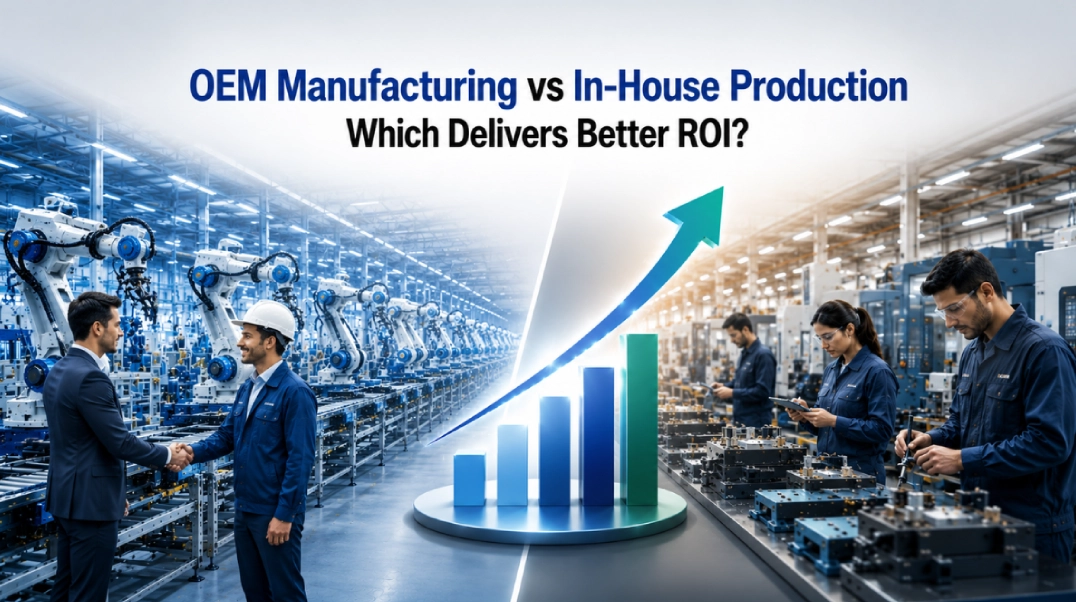
Global manufacturing is becoming increasingly complex, with businesses under pressure to reduce costs, accelerate production, and improve profitability. As a result, the debate between OEM manufacturing and in-house production has become more relevant than ever.
Should companies invest heavily in their own facilities and workforce, or partner with an experienced OEM manufacturer that already has the infrastructure and expertise in place? The answer lies in understanding manufacturing ROI.
Manufacturing ROI goes beyond minimizing costs – it involves maximizing profitability while balancing investment, efficiency, scalability, quality, and speed-to-market. Choosing the right manufacturing model can improve cash flow, reduce risk, and support long-term growth.
To make an informed decision, it is essential to evaluate how each approach impacts both short-term performance and long-term returns. In this blog, we will explore the key factors that influence manufacturing ROI and compare OEM manufacturing with in-house production to help you determine the best approach for your business.
Return on Investment (ROI) in manufacturing refers to the value a business gains from its production activities relative to the costs involved.
Manufacturing ROI is not limited to production expenses. It includes factors such as:
A manufacturing strategy that appears cheaper initially may actually generate lower ROI over time due to inefficiencies, delays, or high operating costs. The goal is to identify the production model that maximizes profitability while minimizing risk.
When evaluating manufacturing strategies, many businesses focus only on direct production expenses. However, several hidden costs can significantly impact ROI. Common overlooked costs include:
Accounting for these factors provides a more accurate picture of total manufacturing costs.
Before comparing ROI, it’s important to understand how each manufacturing model works.
OEM (Original Equipment Manufacturer) manufacturing is a relationship between an OEM and a specialized manufacturer that produces products as per your branding, quality, and specifications.
The OEM takes care of the production process, procurement, manufacturing, quality control, as well as associated packaging processes. This leads into your business retaining ownership of the product design, brand and market strategy.
By outsourcing manufacturing to an OEM, a company can benefit from existing production expertise without making a significant investment in manufacturing facilities.
In-house production involves a company having their own manufacturing facilities, machines, workforce, and production processes.
Companies can exercise full oversight of manufacturing processes, quality management, production planning and innovation. They are also liable for all related expenses, risks, and operational challenges.
This model is often utilized by companies that have very niche products, their own technologies or require long-term output runs.
Manufacturing ROI is influenced by much more than production costs alone. Every decision, from capital investment to scalability and compliance, directly affects profitability and operational efficiency. Understanding these factors helps businesses identify which manufacturing model is better positioned to deliver sustainable returns.
One of the most significant differences between OEM manufacturing and in-house production is the level of capital investment required.
In-house manufacturing demands substantial upfront investments in:
OEM manufacturing significantly reduces these costs because the manufacturing partner already possesses the necessary infrastructure and expertise.
For businesses looking to preserve cash flow and reduce financial risk, OEM manufacturing often delivers a faster ROI.
In today’s competitive environment, speed matters.
Setting up an in-house manufacturing operation can take months or even years. Facility development, equipment installation, hiring, and process optimization all contribute to delays.
OEM manufacturers already have established production systems, enabling businesses to launch products much faster.
Faster product launches can lead to:
The ability to enter the market quickly often has a direct impact on ROI.
Quality issues can significantly reduce profitability through product returns, customer dissatisfaction, and reputational damage.
In-house production provides direct oversight of every manufacturing process. Businesses can implement customized quality control systems tailored to their exact requirements.
However, experienced OEM manufacturers often maintain advanced quality assurance programs, standardized processes, and industry certifications that ensure consistent product quality at scale.
The key is selecting a manufacturing partner with proven quality management capabilities.
Market demand rarely remains constant.
In-house production may struggle to scale quickly without additional investments in equipment, labour, and facility expansion.
OEM manufacturing offers greater flexibility by allowing businesses to adjust production volumes based on demand fluctuations.
This scalability helps companies:
Greater flexibility often translates into improved ROI over time.
Successful businesses thrive when they focus on their strengths.
Managing manufacturing operations requires substantial time, resources, and expertise. For many companies, this can distract from core activities such as:
OEM partnerships allow businesses to concentrate on strategic growth initiatives while manufacturing experts handle production.
This focus can accelerate innovation and improve overall business performance.
Modern consumers and regulatory authorities increasingly demand sustainable and compliant manufacturing practices.
Maintaining compliance requires continuous investment in:
Established OEM manufacturers often have dedicated compliance teams and sustainability programs already in place.
Partnering with a compliant manufacturer can reduce risk and lower operational costs associated with regulatory requirements.
Both models have unique advantages. OEM manufacturing offers flexibility, lower investment, and faster market entry, while in-house production provides greater control and ownership. The comparison below outlines key differences impacting manufacturing ROI and long-term growth.
| Factor | OEM Manufacturing | In-House Production |
|---|---|---|
| Initial Investment | Low | High |
| Operating Costs | Predictable | Variable |
| Time-to-Market | Faster | Slower |
| Production Control | Moderate | Complete |
| Scalability | High | Moderate |
| Manufacturing Expertise | Specialized Partner | Internal Team |
| Compliance Management | Shared Responsibility | Full Responsibility |
| Financial Risk | Lower | Higher |
| Focus on Core Business | Strong | Limited |
| Long-Term Flexibility | High | Moderate |
It’s not a one-size-fits-all situation. The right manufacturing model depends upon your business priorities, resources and long-term objectives. When deciding, take the following into account:
Finally, it all comes down to control, cost, scalability and speed. Both the production system and the broader context need to be understood to determine which manufacturing model would offer the best long-term return on investment for your enterprise.
A structured evaluation process can help businesses select the right manufacturing strategy.
Consider:
Evaluating these factors holistically provides a clearer picture of which model will generate the highest ROI.
OEM manufacturing is often the preferred choice when businesses:
For growing brands, OEM partnerships often provide the most efficient path to profitability.
In-house manufacturing may be more suitable when businesses:
In these situations, long-term operational control may outweigh the higher initial investment.
Many successful companies adopt a hybrid manufacturing approach.
Under this model, businesses retain certain production activities internally while outsourcing specific processes or product lines to OEM partners.
A hybrid strategy can offer:
For many organizations, combining the strengths of both models delivers the optimal balance between control and efficiency.
OEM manufacturing has become increasingly popular across multiple sectors, including:
These industries often benefit from the specialized expertise, economies of scale, and operational efficiencies that OEM manufacturers provide.
Jindal Lifestyle is a trusted OEM manufacturing partner that meets the highest standards of quality with efficiency and scalability. With extensive manufacturing capacity, high-end production facilities, quality control, and emphasis on innovation, companies can enter the market quickly with high-quality products.
Jindal Lifestyle’s manufacturing skills and flexible production solutions enable brands to optimize costs, enhance operational efficiency, and maximize ROI in the long run.
Jindal Lifestyle offers reliability and manufacturing excellence, whether you need to launch a new product line or grow an existing business.
The best manufacturing method isn’t necessarily the best; it’s the one that works best for your business goals.
In-house production gives control and ownership, but requires substantial investment, high operations complexity, and is challenging to scale. However, OEM manufacturing can be a valuable option for businesses looking to lower their capital investment, accelerate time to market and get expertise in manufacturing other specialized technologies that might not be found elsewhere.
In today’s fast-paced business landscape, particularly for companies aiming to scale efficiently and gain a competitive advantage, OEM manufacturing has become more than just an outsourcing choice; it is a strategy. The selection of the appropriate manufacturing model and collaboration with an expert manufacturer can help businesses minimize expenses, optimize production and create a better trajectory towards long-term profitability and sustainable development.
OEM manufacturing involves partnering with an external manufacturer that produces goods according to your specifications, while in-house production requires a company to own and manage its manufacturing facilities, workforce, equipment, and production processes.
OEM manufacturing generally delivers faster ROI because it requires lower capital investment and offers greater scalability. However, in-house production may provide better long-term returns for businesses with proprietary products and consistently high production volumes.
Not necessarily. Reputable OEM manufacturers follow strict quality control processes, industry certifications, and standardized production systems. Choosing an experienced manufacturing partner often results in product quality that is consistent, reliable, and scalable.
OEM manufacturers already have established facilities, skilled teams, and production processes in place. This eliminates the time required to build infrastructure, enabling businesses to launch products faster and respond more quickly to market opportunities.
Yes. One of the biggest advantages of OEM manufacturing is scalability. Production volumes can be increased or adjusted based on market demand without requiring significant investments in additional equipment, facilities, or workforce expansion.
Jindal Lifestyle provides OEM manufacturing solutions across industries such as home textiles, apparel, consumer goods, furniture, packaging, and other lifestyle segments, helping brands achieve efficient, scalable, and high-quality production.

 Stainless Centre, Plot No.50,

